Actin & cell migration
TB-500 and thymosin beta-4
A short actin-binding sequence sits inside a much larger protein. The experiments become clearer once those two molecules have separate names.
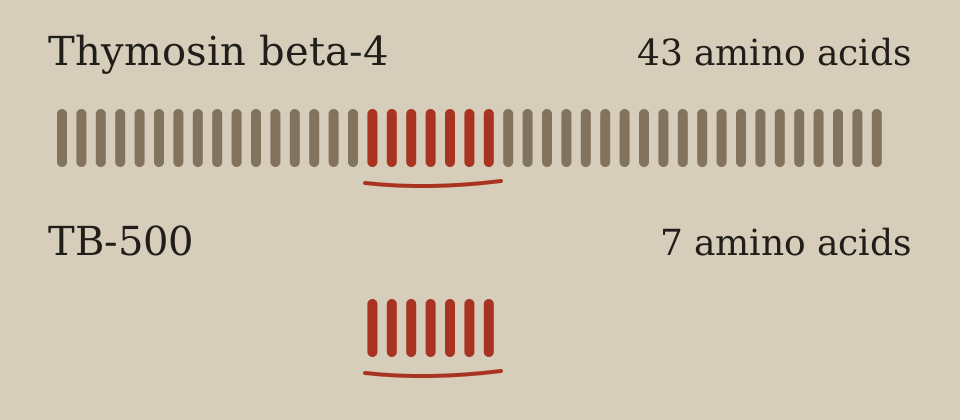
Seven amino acids within forty-three
TB-500 is the synthetic, acetylated sequence Ac-LKKTETQ: seven amino acids corresponding to residues 17–23 of thymosin beta-4. The parent protein contains 43 amino acids and is encoded by TMSB4X. Their approximate molecular weights are ~889 Da and ~4,963 Da respectively. In anti-doping analysis and commerce, TB-500 names the fragment; most repair experiments used full-length thymosin beta-4.
I resent how easily the shared name erases that difference. The 2026 review of peptide therapies offers no completed controlled clinical trial establishing efficacy of the TB-500 fragment for any indication. A convincing experiment with the larger molecule gives a reason to test the smaller one. Its result still has to be earned.
Actin held ready
The 2004 crystallography study used a gelsolin-domain–thymosin beta-4 hybrid bound to actin. At 2-angstrom resolution, the structure showed a 1:1 complex capping both ends of an actin monomer. Holding a monomer apart prevents it from polymerizing—joining other units into a filament. This is a molecular structure, with no patients or recovery outcome.
The biological appeal is regulation: the parent protein buffers a pool of free actin that cells can draw on as their internal skeleton changes. A 2012 review of thymosin beta-4 describes cell migration, reduced scar-forming myofibroblasts, anti-inflammatory and anti-apoptotic signaling, progenitor-cell recruitment and angiogenesis across research models. Platelets and macrophages release the parent protein after injury. The protein’s economy delights me: it participates in so many processes. Blanket claims for the isolated fragment seem much less economical to me.
When the dose response turned
Full-length thymosin beta-4 produced a result that resists the usual escalation story. In male Wistar rats with embolic stroke, intraperitoneal treatment at 2 and 12 mg/kg improved neurological function. The 18 mg/kg group showed no significant benefit. These figures belong to the rat experiment.
The result establishes an uneven response in that model, without explaining why the highest amount lost its apparent advantage. An explanation of that reversal would mean more to me if another laboratory could reproduce it. It also makes casual loading rationales sound especially premature.
Other findings complicate the picture. The literature summarized in the repair and sports-medicine reviews includes dystrophin-deficient mice with more regenerating fibers yet no improvement in muscle strength, cardiac function or fibrosis, and a porcine cardiac experiment in which systemic thymosin beta-4 failed to reduce ischemia-reperfusion injury.
Full-length thymosin beta-4 in humans
A randomized, placebo-controlled Phase 1 trial in 40 healthy volunteers gave synthetic full-length thymosin beta-4 intravenously. The study tested 42, 140, 420 or 1260 mg, with a single administration followed by daily administration for 14 days. It found infrequent mild-to-moderate adverse events, no dose-limiting toxicities or serious adverse events, and dose-proportional pharmacokinetics.
Those are useful safety and pharmacokinetic observations for the full protein under the trial’s conditions. The seven-amino-acid TB-500 fragment still lacks validated human pharmacokinetics and controlled human efficacy trials. No human treatment amount follows from this page.
Migration has difficult implications
The biological review makes the connection between cell migration, vessel growth and repair clear; those same activities create a theoretical concern about tumor progression. Clinical harm from TB-500 has not been quantified.
TB-500 has no approved therapeutic indication and is prohibited by WADA in and out of competition. Anti-doping work has encountered it in racehorses and developed detection methods for equine and human samples. Unknown identity and purity in research-grade material add uncertainty to an already thin human record, as discussed in the sports-medicine review.
Reports of looser joints, flexibility, easier injury recovery and reduced soreness are anecdotal, outside clinical evidence. So are reports of local reactions, lethargy, headache, nausea or mood changes. I distrust probabilities assembled from forum posts. KLOW carries this fragment into a mixture with further unanswered questions.